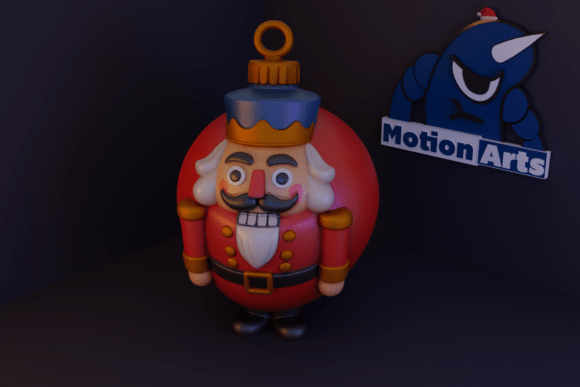
Bringing Tradition to Life: The Nutcracker Christmas Ball 3D Printable Model
The holiday season is defined by rituals, decorations, and the tangible objects that bring warmth to our homes. Among these, few symbols are as instantly recognizable as the Nutcracker. Traditionally crafted from wood and painted with intricate detail, these figures have guarded mantels and tabletops for generations. However, the intersection of traditional aesthetics and modern manufacturing has given rise to a new way to experience this classic icon: the Nutcracker Christmas Ball. This specific 3D printable model offers a unique blend of nostalgic charm and contemporary accessibility, allowing creators, hobbyists, and families to produce high-quality ornaments with relative ease.
Unlike complex figurines that require advanced modeling skills or expensive resin printers, this design prioritizes simplicity and stability. It is engineered specifically for fused deposition modeling (FDM) printers, making it an ideal project for those looking to expand their repertoire of holiday decorations without encountering the frustrations often associated with intricate 3D prints. By focusing on smooth, well-defined shapes and a spherical form factor, the model ensures excellent finish quality even for beginners.
Design Philosophy and Structural Integrity
The primary challenge in 3D printing decorative items is balancing aesthetic appeal with printability. Many ornate designs suffer from overhangs, fragile protrusions, or warping issues that can ruin hours of printing time. The Nutcracker Christmas Ball addresses these challenges through a thoughtful design philosophy that places structural integrity at the forefront. The character is encapsulated within or integrated into a spherical geometry, which inherently provides stability during the printing process. This shape minimizes the risk of the object detaching from the print bed, a common issue with tall, thin structures.
Furthermore, the surfaces are designed to be smooth and well-defined. This attention to surface topology means that layer lines are less noticeable, resulting in a professional-looking finish straight off the printer. For users who may not have extensive post-processing tools or patience for sanding and priming, this feature is invaluable. The design allows the natural texture of the filament to contribute to the charm of the piece rather than detracting from it. Whether using standard PLA, PETG, or specialty filaments like silk or matte varieties, the model adapts well, showcasing the material's properties effectively.
Accessibility for Beginners and Educators
One of the most significant advantages of this model is its classification as a beginner-level project. In the world of additive manufacturing, there is often a steep learning curve associated with moving beyond simple calibration cubes and benchy boats. The Nutcracker Christmas Ball serves as an excellent bridge between basic tests and functional, decorative art. It requires support structures, which provides a practical learning opportunity for users to understand how supports work, how to remove them cleanly, and how they affect surface quality.
Educators and workshop leaders will find this model particularly useful for teaching fundamental concepts of 3D printing. It demonstrates important principles such as orientation, support generation, and layer adhesion in a context that is engaging and rewarding. Students or novice makers can see immediate, tangible results that have real-world application—decorating their own spaces or creating gifts. This sense of accomplishment is crucial for maintaining interest in STEM fields and fostering creativity. The lightweight nature of the final print also means that material costs are low, allowing for multiple attempts and iterations without significant financial burden.
Versatile Applications in Holiday Decor
The utility of the Nutcracker Christmas Ball extends far beyond a single use case. Its compact size and durable construction make it suitable for various decorative applications throughout the home and community.
- Tree Ornaments: The most obvious application is as a hanging ornament. With the addition of a small loop or hook design element, these balls can be suspended from Christmas tree branches, adding a personalized touch that mass-produced plastic ornaments cannot match.
- Table Centerpieces: Printed in larger scales or grouped together, these balls can serve as part of a festive table centerpiece. When printed in metallic gold, silver, or traditional red and green filaments, they complement other holiday decor elements beautifully.
- Gift Toppers: Instead of traditional bows, these printed balls can be attached to gift packages as reusable toppers. They add a three-dimensional element to gift-giving and can become keepsakes for the recipient.
- Community Projects: Schools, libraries, and community centers can organize printing events where participants create these ornaments to donate to local hospitals, nursing homes, or shelters. The simplicity of the file allows for batch production, enabling groups to create dozens of unique decorations quickly.
This versatility ensures that the model remains relevant not just for individual hobbyists but for organizations looking to engage communities in creative activities during the holiday season.
Technical Considerations for Optimal Results
To achieve the best possible outcome when printing the Nutcracker Christmas Ball, users should pay attention to several technical parameters. While the model is forgiving, optimizing slicer settings can significantly enhance the final appearance.
First, consider the infill density. Since this is a decorative item that does not need to bear heavy loads, an infill of 15% to 20% is typically sufficient. This balances strength with material efficiency and print speed. However, if you plan to hang the ornament, ensuring adequate wall thickness is crucial. Increasing the number of perimeters or walls can provide the necessary durability to withstand handling and hanging tension.
Support structures are required for this model, as indicated by the design specifications. It is recommended to use tree supports or organic supports if your slicer software allows, as these are often easier to remove and leave fewer marks on the model surface compared to traditional grid supports. Careful removal of supports using flush cutters or a hobby knife will preserve the smooth contours of the Nutcracker’s face and uniform.
Layer height also plays a critical role in the visual quality. A layer height of 0.2mm is a good standard for balancing speed and detail. For those seeking a finer finish, reducing the layer height to 0.12mm or 0.16mm can result in smoother curves, particularly on the spherical parts of the ball. However, this will increase print time, so users should weigh the desire for perfection against the availability of their printer.
Material Selection and Aesthetic Customization
The choice of filament can dramatically alter the character of the Nutcracker Christmas Ball. Standard PLA is the most recommended material due to its ease of printing and wide color availability. It produces sharp details and holds up well in indoor environments. For a more premium look, silk PLA can mimic the appearance of polished metal or ceramic, adding a luxurious feel to the ornament without the weight or cost of actual metal.
For those interested in a multi-color effect, there are several approaches. Users can pause the print at specific layer heights to change filament colors, allowing for custom color blocking on the Nutcracker’s uniform or hat. Alternatively, using dual-extrusion printers or AMS (Automatic Material System) units can enable seamless color transitions. Even without multi-color capabilities, painting the finished print offers endless creative possibilities. Acrylic paints adhere well to PLA, allowing for detailed hand-painting that can replicate the traditional wooden look or introduce modern, whimsical color schemes.
Fostering a Culture of Making
Beyond the physical object, the Nutcracker Christmas Ball represents a shift towards personalized consumption. In an era where mass-produced goods dominate the market, taking the time to design, slice, and print a decoration adds emotional value. It connects the maker to the tradition of crafting, albeit through digital means. This process encourages problem-solving, patience, and artistic expression.
For businesses, offering such files or printed products can tap into the growing demand for unique, eco-friendly decor. Since 3D printing allows for on-demand production, there is no need for large inventory stocks, reducing waste. Small businesses can offer customization options, such as adding names or dates to the base of the ball, creating highly personalized gifts that resonate with customers.
In conclusion, the Nutcracker Christmas Ball is more than just a STL file; it is a gateway to creative exploration during the holiday season. Its design respects the limitations of entry-level hardware while delivering a result that is visually appealing and structurally sound. Whether you are a teacher introducing students to 3D printing, a parent looking for a fun family activity, or a designer expanding your portfolio of holiday assets, this model offers a reliable and charming solution. By embracing the simplicity and stability of this design, makers can let the Christmas spirit take shape, one layer at a time.